A useful container tells you what is inside before you open it, shows when supplies are running low, and lets you take out what you need without a struggle.
Clear tubs, glass containers and big glass jars can all do that job. The best shape depends on whether you lift out wrapped items, scoop ingredients or pour directly into something else. Start with that everyday action before buying a matching set.
Choose the format by what you store
Clear container formats and their trade-offs| Format | Useful for | Access and serving | Check before choosing |
|---|
| Open clear tub or handled bin | Wrapped snacks, packets and groups of small packages | Lift out a package or carry the group | No sealed closure; a general organizer is not automatically intended for loose food |
| Lidded clear plastic tub | Food storage where a lighter container is easier to handle | A broad opening can suit a scoop; a smaller pouring edge may suit dry ingredients | Direct-food-contact suitability, closure design and the loaded grip |
| Square pantry canister | Rice, flour, sugar, pasta or a frequently used dry-food category | Lift the lid, then pour from a corner or use a scoop | Enough room to remove the lid; square does not guarantee a comfortable pour |
| Rectangular glass food container | Smaller food portions and ingredients you prefer to scoop or lift out | Wide access with a removable lid | Glass base and lid can have different care instructions; assess filled weight |
| Large hinged glass jar with gasket and latch | Wrapped coffee pods, snacks and visible pantry staples | Open the attached lid and pick out items or scoop | Open-lid swing, clamp access, gasket condition and loaded weight |
The coffee-pod jar is a useful model
A large clear jar with a hinged lid and latch makes a simple storage station: you can see how many pods remain, open one attached lid and lift out a pod. It also gives the container a defined place on the counter instead of leaving a partly empty box beside the machine.
For individually sealed pods, the visible stock level and easy access are the reasons to choose the jar. We do not claim that an outer airtight jar improves the freshness of an already sealed pod. Check the pod’s own packaging for storage guidance.
The same arrangement can work for wrapped snack portions or other small packaged items. Jar volume alone will not tell you the exact item count: shape, arrangement and the opening all matter. Use the hinged-jar fit and closure guide before choosing a size.
Clear does not always mean easy to see
Place tall containers where their front and fill level remain visible. A deep row of clear jars can still hide the back row. Put a small label low on the front rather than covering the whole viewing area, and keep ingredient identity and relevant package/date information with decanted food.
Lift out
For pods and wrapped snacks, check hand access and whether the item passes through the mouth comfortably.
Scoop
For flour or other ingredients you measure, check the actual scoop with the lid open. A wide body can still have a narrow neck.
Pour
For dry ingredients, consider the opening, a usable grip and the target container. A spout, corner or funnel may offer better control than a large round mouth.
Choose the closure separately from the material
“Glass jar” does not establish airtightness. A loose lift-off lid, a screw lid, a push-button seal and a hinged gasket closure operate differently. Look for a documented closure and compatible seal, then follow the selected product’s instructions. Airtight storage is a manufacturer claim unless a relevant test is documented.
Size for the refill and the shelf
Compare volume with volume: liters, quarts or cups. A bag’s weight in pounds does not convert directly to a container’s volume without knowing the ingredient and how it packs. Leave usable room for the closure and serving action rather than filling to an assumed brim capacity.
Check the exterior footprint with the lid shut and the space required with it open. For a heavy glass jar, decide where you will set it while using it; lifting a full jar down from a high shelf may be inconvenient even when it fits.
Two researched starting points
As an Amazon Associate I earn from qualifying purchases. These are published-source product briefs, not hands-on tests. Illustrations are labelled schematics; Amazon photo access is not active.
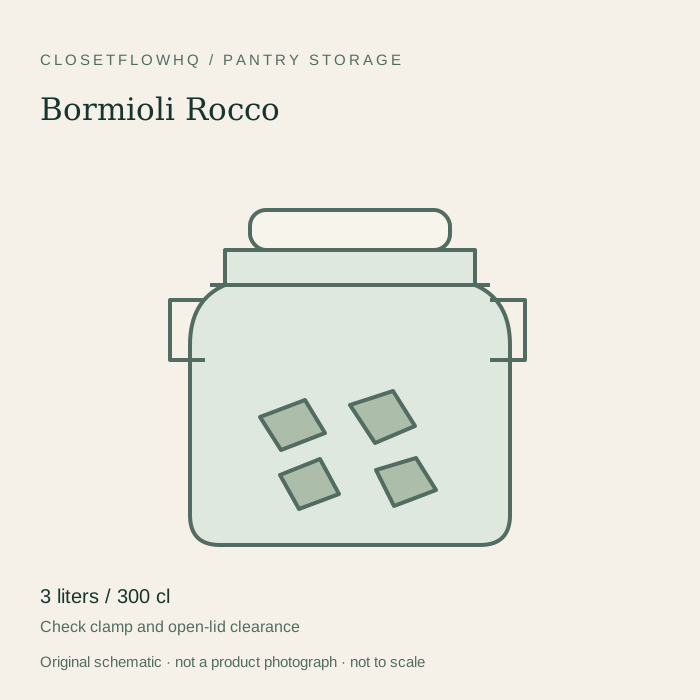
Bormioli Rocco · Fido 300 cl / 1.49250
Consider for: Visible countertop storage for wrapped coffee pods, snacks or dry pantry ingredients.
Limit:A full glass jar can be awkward to lift and pour; its hinged lid also needs room behind and above the jar.
Original ClosetFlowHQ schematic, not a product photograph. Shape simplified; not to scale.
Dimensions, fit notes & sources →Check this model on Amazon ↗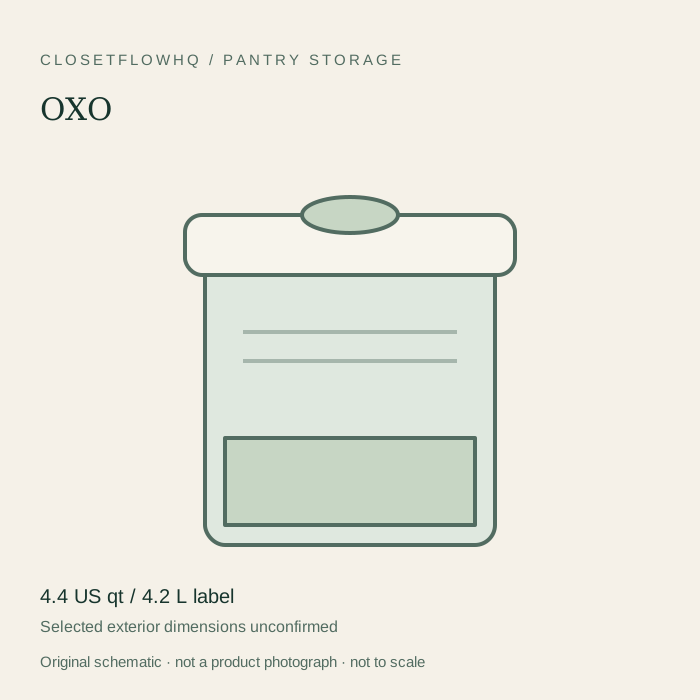
OXO · POP Big Square Medium, white-lid listing
Consider for: Dry pantry ingredients when a removable lid and square footprint suit the shelf.
Limit:It has no dedicated pouring spout; a large container may work better with a scoop.
Original ClosetFlowHQ schematic, not a product photograph. Shape simplified; not to scale.
Dimensions, fit notes & sources →Check this model on Amazon ↗